How to Analyze Rap Lyrics (Beyond the Rhyme Scheme)
Why reading rap lyrics off a page misses the point
Most lyric breakdowns treat a rap verse like a high school poetry assignment: print out the text, highlight the words at the ends of the lines, and look up whatever slang seems unfamiliar on a wiki. That approach misses almost everything that makes rap compelling.
Rap is the only mainstream genre where the voice acts simultaneously as percussion, narrative narrator, and harmonic counterpoint. In pop, melody and chord resolution carry the emotional weight; the lyric can afford to stay simple. In hip-hop, the verse bears the entire weight of the composition. If you only look at end-rhymes on a flat screen, you miss the tempo shifts, internal cadence, breath control, and regional codes that give the words their real meaning.
To analyze rap lyrics thoroughly, you need to break the verse down across four interconnected layers.
The 4-layer framework for analyzing rap lyrics
1. Rhyme architecture: internal density and multisyllabics
Basic poetry analysis counts end-rhymes (AABB or ABAB). Skilled MCs rarely rely on simple end-rhymes alone. The true engine of rap lyricism is rhyme density — how many phonetic rhymes are packed into a single bar.
Key mechanics to map:
- Multisyllabic rhymes (compound rhymes): Rhyming strings of multiple syllables rather than just the final vowel (for example, matching "crazy condition" with "daily ambition").
- Internal rhyming: Rhymes that strike within the bar, setting off chain reactions before reaching the line ending.
- Assonance and consonance: Slant rhymes where identical vowel sounds or consonant clusters link words together even when they do not officially rhyme in a dictionary.
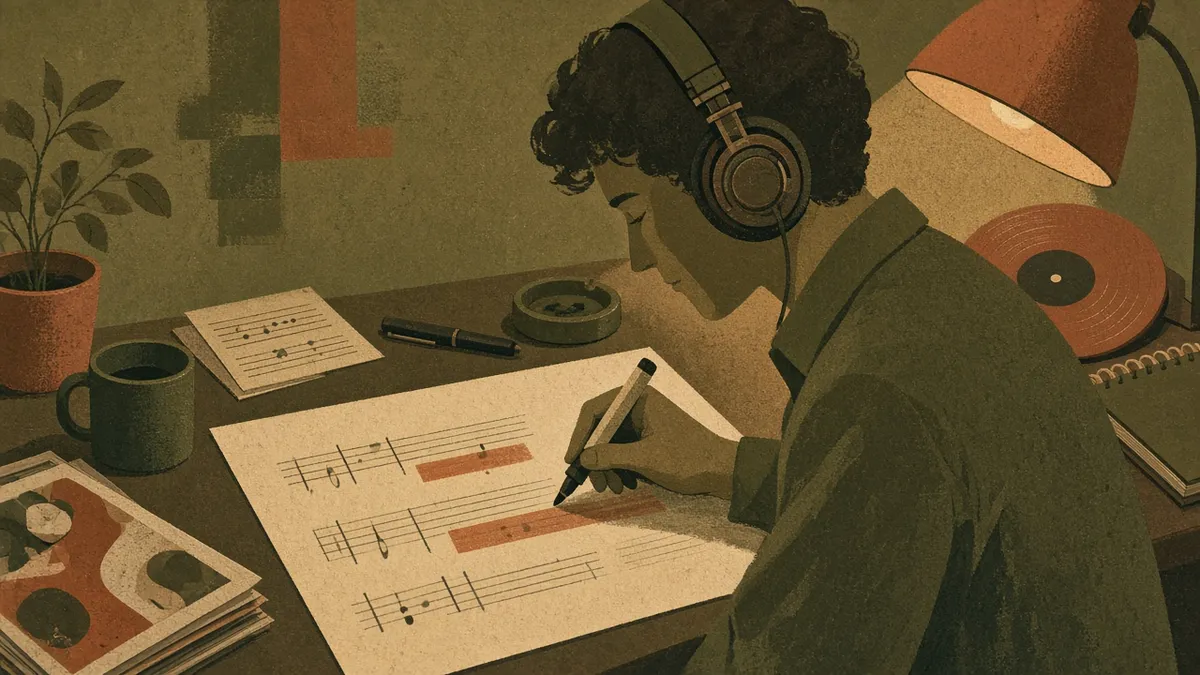
When marking up a verse, color-code matching vowel sounds across the lines. You will quickly see that elite lyricists do not write line-by-line; they construct interlocking phonetic matrices.
2. Flow, cadence, and the rhythmic pocket
Cadence is not just how fast someone raps — it is how syllables align with the musical grid. A bar of 4/4 time has four quarter-note beats, usually punctuated by a kick on beat 1 and a snare on beats 2 and 4.
Examine where the words land relative to the drum pattern:
- Sitting in the pocket: Landing stresses dead-center on the beat, producing an effortless, authoritative groove.
- Syncopation and dragging: Hitting slightly behind or ahead of the snare to create tension, suspense, or a conversational feel.
- Subdivision shifts: Switching smoothly between straight eighth notes, sixteenth notes, and triplets (the famous "Migos flow") within the same verse.
- Rests and negative space: Where the rapper intentionally stops. A sudden breath or pause right before a punchline often delivers more dramatic impact than five syllables packed into that same space.
3. Wordplay registers: double entendres and extended metaphors
Rap uses compression: conveying three separate ideas in a seven-word couplet. Decoders often get distracted by literal jokes ("punchlines") and miss the deeper thematic registers running underneath.
Look for three levels of wordplay:
- Double and triple entendres: Lines that carry two or three coherent meanings simultaneously (e.g., a sports reference that also comments on a drug trial and a financial dispute).
- Homophones and auditory puns: Words that sound identical when voiced in a specific regional accent, even if spelled differently.
- Extended metaphors (conceits): A single underlying comparison sustained across 8, 12, or 16 bars — such as discussing the music industry entirely in terms of an abusive romance or a high-stakes poker game.
4. Cultural, historical, and geographic context
A rap verse never exists in a vacuum. It is anchored to a specific neighborhood, era, economic climate, and cultural conversation. Taking lines purely literally without knowing their context leads to gross misinterpretations.
- Documentation vs. endorsement: Rappers frequently document trauma, survival strategies, and systemic pressure as journalists or eyewitnesses. Confusing descriptive storytelling with moral endorsement is one of the most common reading errors.
- Regional lexicon: Slang that signifies one thing in South London may mean something completely different in Atlanta or Toronto. Always verify phrases within the artist's local scene.
- Subgenre lineage: A boom-bap verse from 1994 values intricate internal rhyming and pocket control; a Southern trap verse from 2018 prioritizes bounce, ad-libs, and percussive phrasing; modern drill centers ominous sliding basslines and narrative friction. Judge the craft by the rules of its lineage.
How to run a 3-pass analysis
To avoid getting overwhelmed, use this three-stage routine whenever dissecting a complex verse:
- Pass 1: Pure audio (no lyrics sheet). Close your eyes and listen on headphones. Track where your neck bobs, where the rhythm surprises you, and where the vocal delivery tightens or loosens. Note your gut reaction.
- Pass 2: Visual close read. Pull up the transcription. Map the multisyllabic rhyme schemes, circle the double meanings, and identify any cultural references that need research.
- Pass 3: Audio and text together. Listen again while following your annotated text. Notice how the vocal delivery brings the written rhymes to life and where the pauses create meaning.
Synthesizing your findings
Once you finish the passes, summarize your takeaway in a single grounded paragraph:
"In this verse, the MC uses a dense four-syllable rhyme matrix while dragging slightly behind the snare (flow/rhyme). The surface narrative portrays a casual dice game, but the recurring currency references double as a meditation on generational wealth and systemic redlining (wordplay/literal). Written during the economic shift of the late 90s, the verse functions as journalistic documentation rather than empty boasting (context)."
If you want to speed up the process of breaking down rhyme patterns and thematic structures across long songs, you can paste the text into our AI Lyrics Analyzer to get an instant structural and thematic baseline before doing your own deep dive.
Frequently asked questions
Do rappers consciously calculate all these rhyme schemes?
Both consciously and intuitively. Top-tier lyricists spend years internalizing phonetic patterns, syllable meters, and rhyme banks until multisyllabic writing becomes second nature. Some write meticulously with pen and paper; others construct entire verses in their heads like puzzle pieces before stepping into the vocal booth.
What is the difference between flow and delivery?
Flow is the rhythmic architecture — the mathematical timing of how syllables sit on the drum beats. Delivery is the emotional and vocal texture — the raspy voice, whisper, aggression, inflection, and breath control used to perform that rhythm.
Why do online annotations sometimes get rap verses wrong?
Crowdsourced annotations frequently suffer from overreading — finding convoluted conspiracies or numerology where none exists — or underreading, completely missing regional slang, sports idioms, or historical references. Always test an annotation against the actual audio performance before accepting it.
Start Your Song Lyrics Review Journey Today
Join thousands of music lovers who are mastering the art of song lyrics analysis.